Remember the stories, not just the last time you spoke.
Dex and ConvoMemory both help you keep relationships from slipping through the cracks. The choice is about what you want help with: maintaining a connected network, or holding on to the details that make your friendships feel close.
Two different theories of connection.
For friendship and conversation memory
Choose ConvoMemory if your main goal is to remember what friends tell you, revisit personal details before the next catch-up, and get a gentle nudge to reconnect.
For networks and contact consolidation
Choose Dex if you want a broader personal CRM with contact consolidation, interaction history, reminders and integrations across parts of your digital network. Basically, it's a bit more business-y.
Concise comparison.
You want to ask how the interview went.
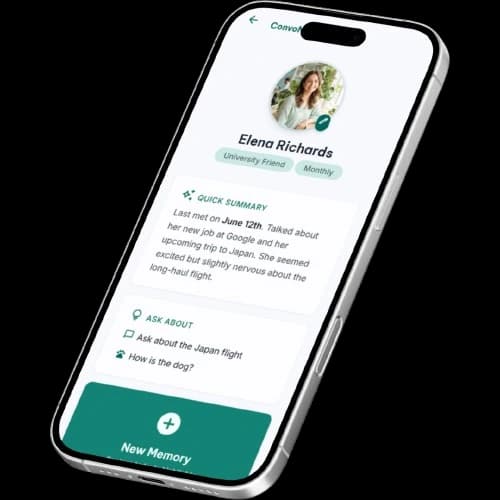
A friend tells you they're nervous about an interview. With ConvoMemory, you drop a 10-second voice blurb on their profile after your call and forget about it; before your next catch-up, you glance at the timeline and ask how it went. With Dex, you open a CRM dashboard to add structured notes, tag the interaction, assign a follow-up task, or rely on its automated calendar/LinkedIn sync to keep the contact visible alongside your professional network.
When to choose each app.
Choose ConvoMemory if:
A focused, personal space for conversation summaries, meaningful details and reconnect reminders - without needing to organise your whole network.
Choose Dex if:
A stronger fit if you value connected contact management, professional-network workflows and integrations as much as personal conversation notes.
Your questions answered.
How much effort does it take to save memories?
ConvoMemory is built for easy capture: drop a quick text or voice note after a catch-up, and ConvoMemory structures it for you. Dex requires ongoing setup and curation - from configuring integrations (LinkedIn, Gmail, Google Calendar) to manually populating custom contact fields and reviewing synced timelines.
What happens to voice notes and personal data?
ConvoMemory prioritizes privacy by processing voice notes on-device and immediately discarding raw audio. Dex stores user data securely in cloud-backed U.S. servers (AES-256 at rest, TLS in transit), but requires broad OAuth permissions to sync and scan your email, calendar, and messaging accounts.
What can you do for free?
ConvoMemory offers a free tier (up to 3 friends), Premium at $10/month, and Annual at $100/year. Dex operates on a subscription-only model with no free tier - offering a 7-day free trial followed by Premium at $20/month and Professional at $34/month plans.
What limitations might matter?
ConvoMemory focuses strictly on qualitative friendship catch-ups without complex integrations. Dex is a broad Personal CRM and networking workspace - making it a better fit if you need multi-channel sync, browser extension tools, map visualizations, and professional contact management.
Is ConvoMemory a good alternative to Dex?
It can be if you mainly want to remember personal conversations and reconnect with friends. Dex is worth considering if you want broader contact management and integrations.
Does ConvoMemory automatically import my conversations?
No. You choose what to capture in a short text or voice blurb. ConvoMemory summarises and organises what you provide.
Which is better for professional networking?
Dex is generally more aligned with broad personal and professional network management. ConvoMemory is designed around personal memories and friendship maintenance.